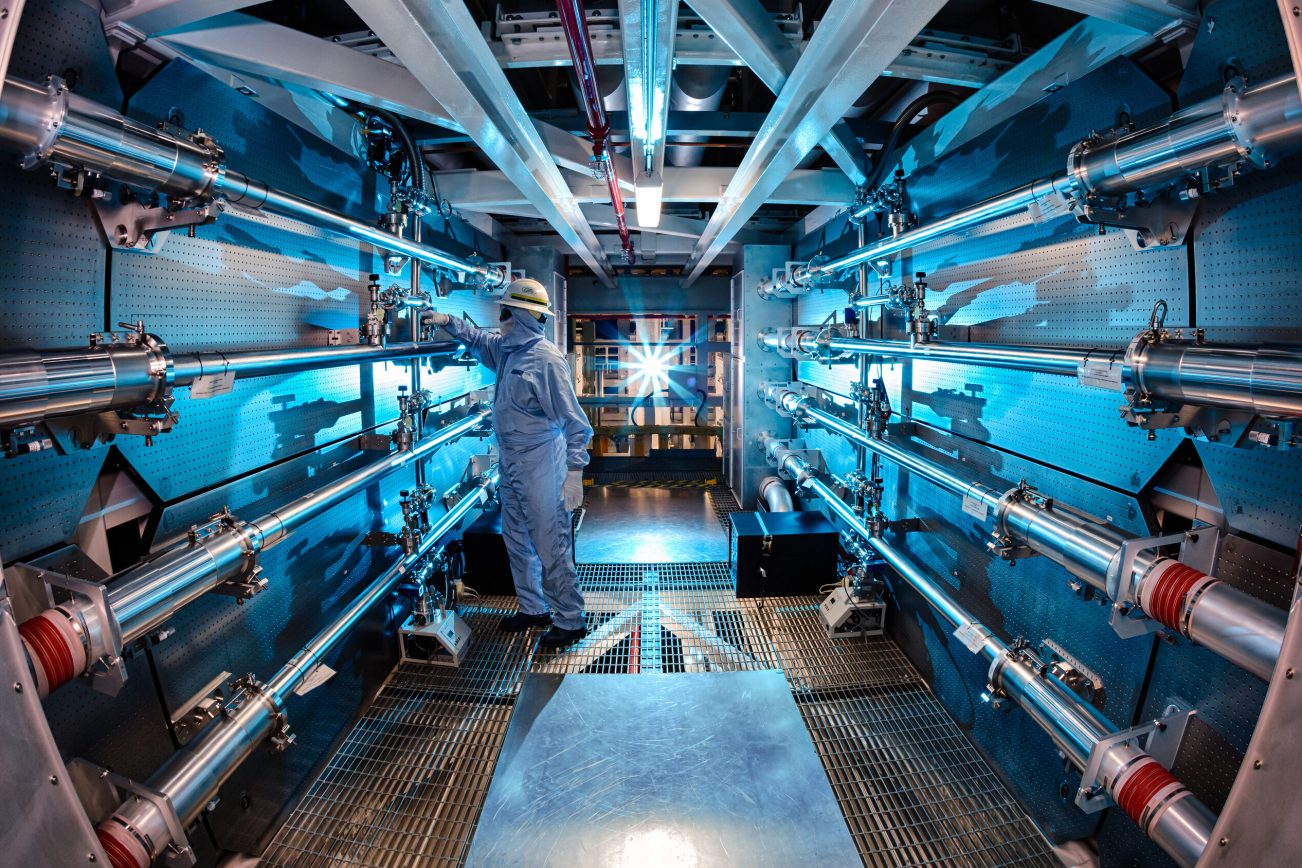

On Tuesday, scientists researching fusion energy at Lawrence Livermore National Laboratory in California announced a historic development in nuclear fusion. For the first time ever, a fusion reaction in a laboratory setting produced more energy than it took to start the reaction. This “net energy gain” is a major milestone in our quest to source clean, limitless energy from nuclear fusion.
Earth Records its Shortest Day as the Planet Spins Faster Than Ever
For decades, scientists have discussed how fusion – the nuclear reaction that makes stars shine – could provide a bountiful energy source. If scientists can use fusion on a large scale, it would offer an energy source without pollution and greenhouse gases caused by burning fossil fuels and the dangerous radioactive waste created by current nuclear power plants.
“This is such a wonderful example of a possibility realized, a scientific milestone achieved, and a road ahead to the possibilities for clean energy,” Arati Prabhakar, the White House science adviser, said during a news conference on Tuesday morning at the Department of Energy’s headquarters in Washington, D.C. “And even deeper understanding of the scientific principles that are applied here.”
The nagging caveat across years of research saw experiments consume more energy than the reactions generated. However, that all changed at 1:03 a.m. on December 5th at the laboratory’s National Ignition Facility.
James Webb Telescope Snaps Shimmering View of the ‘Pillars of Creation’
192 giant lasers blasted a small cylinder that contained a frozen clump of hydrogen encased in diamond. The beams entered at the top and bottom of the cylinder, vaporizing it. This generated an inward onslaught of X-rays that compresses a tiny fuel pellet of tritium and deuterium, the heavier forms of hydrogen. In less than 100 trillionths of a second, 2.05 megajoules of energy – equivalent to roughly a pound of TNT – bombarded the hydrogen pellet. The reaction produced a flood of neutron particles – the products of fusion – carrying about 3 megajoules of energy. While past fusion experiments have generated more energy, none have had nearly as big an energy gain.

Though there are still many more steps until nuclear fusion can be commercially viable to power the electric grid, for example, this is a major hurdle to cross.
Lastly, in case you missed it, Watch NASA’s Orion Spacecraft Fly Past the Moon on Artemis I Mission.