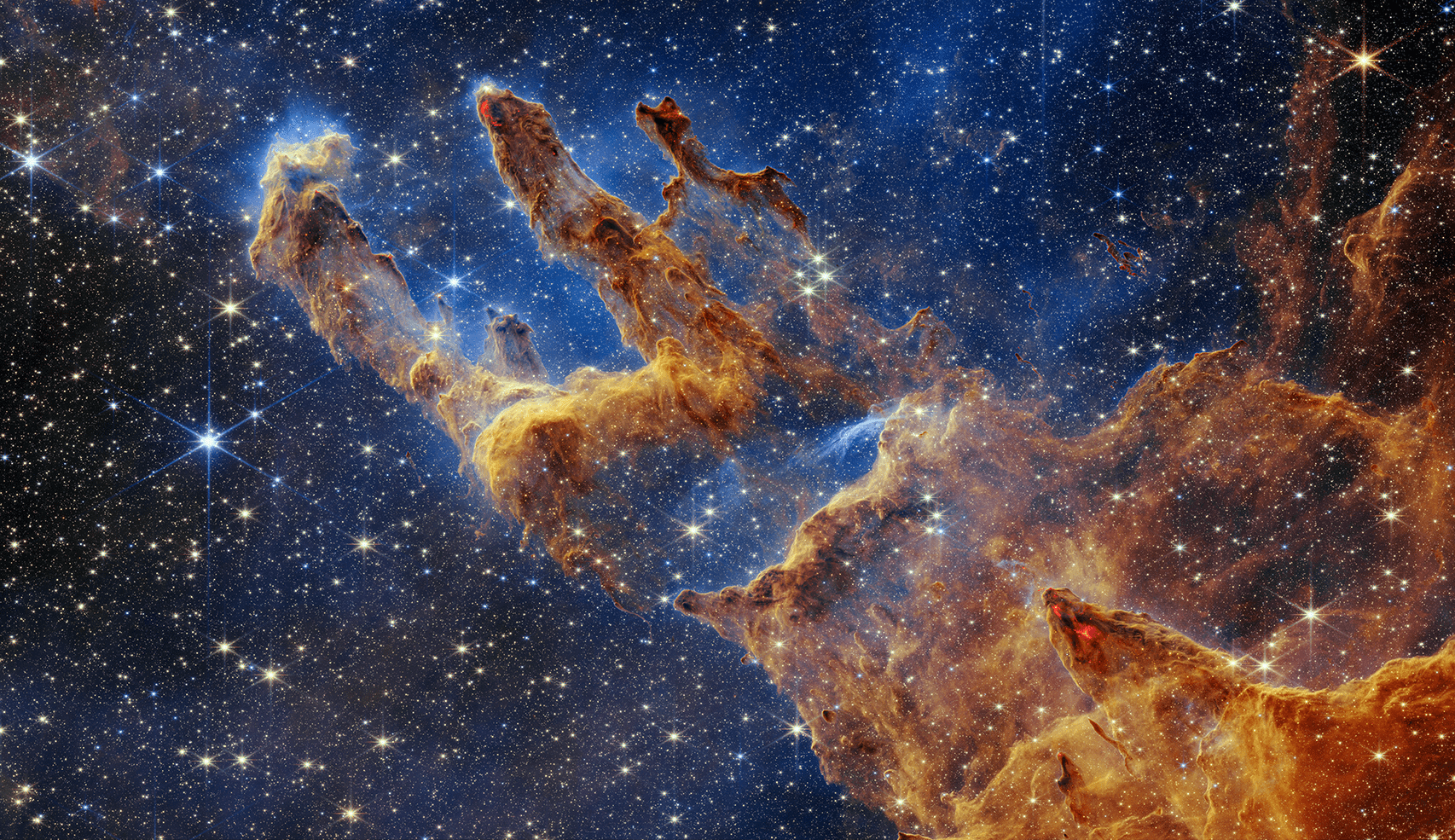

The latest image from NASA’s James Webb Space Telescope shows a lush, highly detailed landscape of the Pillars of Creation.
Astronomers Capture First Image of Black Hole in Milky Way Galaxy
Visually, the Pillars of Creation offer kaleidoscopic colors as arches and spires rise from a desert landscape. Scientifically, the Pillars of Creation are dense clouds of hydrogen gas and dust in the Serpens constellation roughly 6,500 light-years from Earth. The pillars lie central in an active star-forming region that astronomers refer to as Messier 16, or the Eagle Nebula. Thanks to Webb’s infrared detectors, we are able to see past much of the light-scattering effects of the pillars’ dust. Resembling majestic rock formations, the Messier 16’s pillars are illuminated and sculpted by the intense ultraviolet light from massive nearby stars. Such radiation is also what is dismantling the towers.
Newly formed stars steal the show in Webb’s image, appearing as bright red orbs above. These orbs typically have diffraction spikes and lie outside one of the dusty pillars. You’ll also notice wavy lines resembling lava at the edges of some pillars. According to NASA, these are ejections from stars that are still forming within the gas and dust. Young stars periodically shoot out supersonic jets that collide with clouds of material, like these pillars. The crimson glow comes from energetic hydrogen molecules as a product of the jets and shocks.
Though every large telescope has imaged this scene, none offers the remarkable perspective of Webb. Learn more about the latest images from NASA and the James Webb Telescope here.

Lastly, Apple Introduces the Next-Gen iPad Pro with M2 Chip.