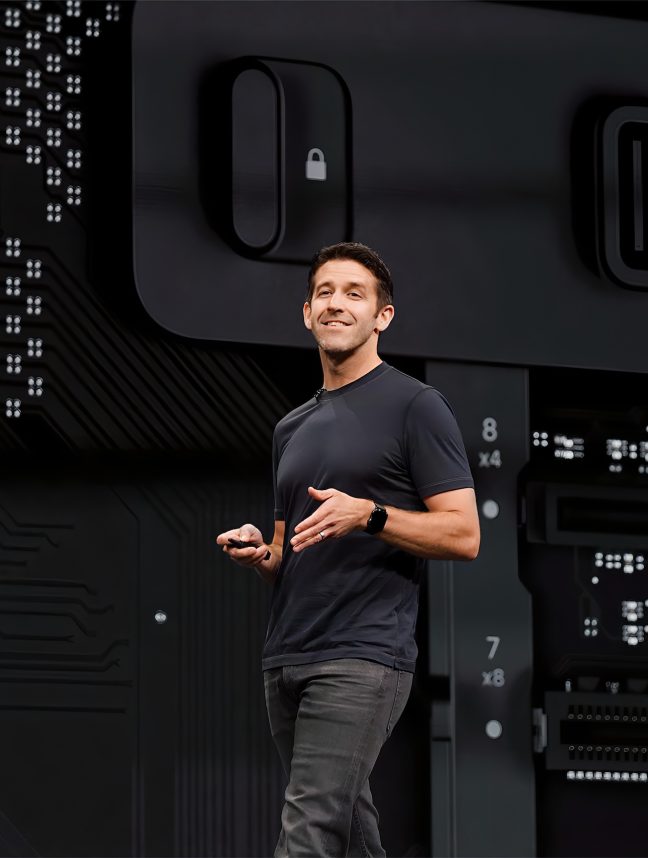

Every few decades, a company that has shaped the world gets a moment that forces the question of whether it can survive its own mythology. Apple has had two of those moments in its history. The first was when Steve Jobs returned in 1997 to a company that had nearly collapsed without him. The second was when he died in 2011 and handed the keys to Tim Cook, a supply chain architect who had never been mistaken for a visionary and proceeded to build the most valuable company in human history anyway. The third moment arrives September 1, 2026, when John Ternus steps into the role that Cook and Jobs before him defined, and begins the process of answering the only question anyone in technology is asking today: what does Apple look like when it is run by the person who actually built the things?
Ternus is 50 years old and has spent exactly half his life at Apple. He joined in 2001 as a member of the product design team, cutting his teeth on the Apple Cinema Display before eventually assuming oversight of the iPad, the Mac, and ultimately the entire hardware engineering operation when he was named senior vice president in 2021. His fingerprints are on every significant physical object the company has shipped in the past decade: the iPhone, the MacBook Neo, the AirPods, the Apple Vision Pro. Before Apple, he designed virtual reality headsets at Virtual Research Systems. Before that, he graduated from the University of Pennsylvania with a degree in mechanical engineering, where his senior project was a mechanical feeding arm operable by people with quadriplegia using head movements. The man who is about to run a $4 trillion company started his engineering career trying to give people back the use of their hands.
Is AI Coming for Your Job? The New Reality for White-Collar Workers
That detail matters because it tells you something about how Ternus thinks. Apple under Jobs was driven by the belief that technology should feel like an extension of the human body. Under Cook, that belief was preserved in the products while the company’s center of gravity shifted toward services, logistics, and the extraordinary discipline of global supply chain management that took Apple from one trillion to four. What Ternus represents is a return to the hardware conviction at the company’s foundation, but with something neither Jobs nor Cook could fully claim: a firsthand understanding of what it actually takes to build the things. He is not a visionary descended from above. He is the person who was in the room when the vision became real.
The challenge waiting for him is the one that has been waiting for Apple for several years now: artificial intelligence. Cook’s legacy is extraordinary by any measure, but the honest accounting of his tenure includes a Siri that fell further behind with every passing year while OpenAI, Google, and Anthropic reshaped the entire landscape around it. Apple’s AI efforts have been cautious and methodical where the moment demanded speed and risk. Forrester principal analyst Dipanjan Chatterjee described Ternus’s background as a signal that Apple will seek differentiation in its physical products even as it tries to reframe the device as a platform for intelligent experiences. That framing is important. It suggests that Apple’s answer to the AI moment may not be a chatbot or a cloud service but something you hold in your hand, something that Ternus himself probably helped design.

Cook is not disappearing. He transitions to executive chairman, a role that keeps him engaged with policymakers and gives the new CEO a resource that Jobs never had: a living predecessor willing to stay close. That continuity matters in a moment of genuine uncertainty. Apple faces a supply chain reshaped by geopolitical tension, the ongoing pressure of tariffs under the current administration, and a semiconductor landscape being restructured by the AI chip demand that shows no sign of slowing. The person inheriting all of that is a mechanical engineer who started his career designing headsets in a company most people have never heard of, joined Apple the year after Jobs came back, and has been building things there ever since.
Apple Officially Retires the Mac Pro Desktop Workstation
“Having spent almost my entire career at Apple,” Ternus said in the announcement, “I have been lucky to have worked under Steve Jobs and to have had Tim Cook as my mentor.” That sentence is doing a lot of work. It is a statement of gratitude but also of lineage, a deliberate acknowledgment that he is not arriving to disrupt Apple’s history but to carry it forward. The question is not whether he is capable. Twenty-five years of building the most scrutinized products on earth answers that. The question is whether carrying the history forward is enough, or whether the moment demands something more like reinvention. September 1 is when we find out which one he has chosen.