Mamoru Hosoda has spent his career asking what animation can do that nothing else can. His early films, including the quietly devastating Wolf Children, answered that question through hand-drawn imagery so tactile it seemed to carry actual weight: children growing up, seasons turning, a mother navigating grief and solitude in real time. Since then, he has been pushing the technical boundary further, layering 3DCG into his work not as spectacle but as a storytelling tool. In 2021’s Belle, the contrast between a girl’s grounded hand-drawn reality and the explosive digital world she escapes into was doing emotional work that the script alone could not. His eighth film, Scarlet, takes that logic further still.
Kanye West Returns With “BULLY” But Has The Culture Actually Forgiven Him
The film is a reworking of Hamlet, set in 16th century Denmark, with a red-haired princess named Scarlet as its protagonist. Where Shakespeare gave us a prince paralyzed by thought, Hosoda gives us a sword-trained teenager seeking vengeance for her father’s murder at the hands of her uncle Claudius. When Claudius poisons her, Scarlet passes into the Otherworld, a purgatory rendered entirely in 3DCG, where epic landscapes unfold in extraordinary detail and lightning-shooting dragons cut across the frame. The hand-drawn Elsinore she leaves behind and the digital Otherworld she enters are not just visual contrasts. They are two different registers of emotional experience. “I approached it less as creating a hybrid form,” Hosoda explains, “and more with the intention of updating the language of animation itself.”
The red hair is deliberate on multiple levels. It signals Scarlet’s anger, the organizing force of the film’s first half, but it also references Queen Elizabeth I, the red-haired queen, grounding the character in a specific tradition of female power that operates within structures designed to contain it. That tension is central to why Hosoda chose a princess rather than a prince. Unlike Hamlet, whose burden is the destiny of a king’s son, Scarlet remains vulnerable to having her voice taken away even while existing inside structures of power. The question the film asks is not whether she will get her revenge but whether she will choose to let revenge define her life.
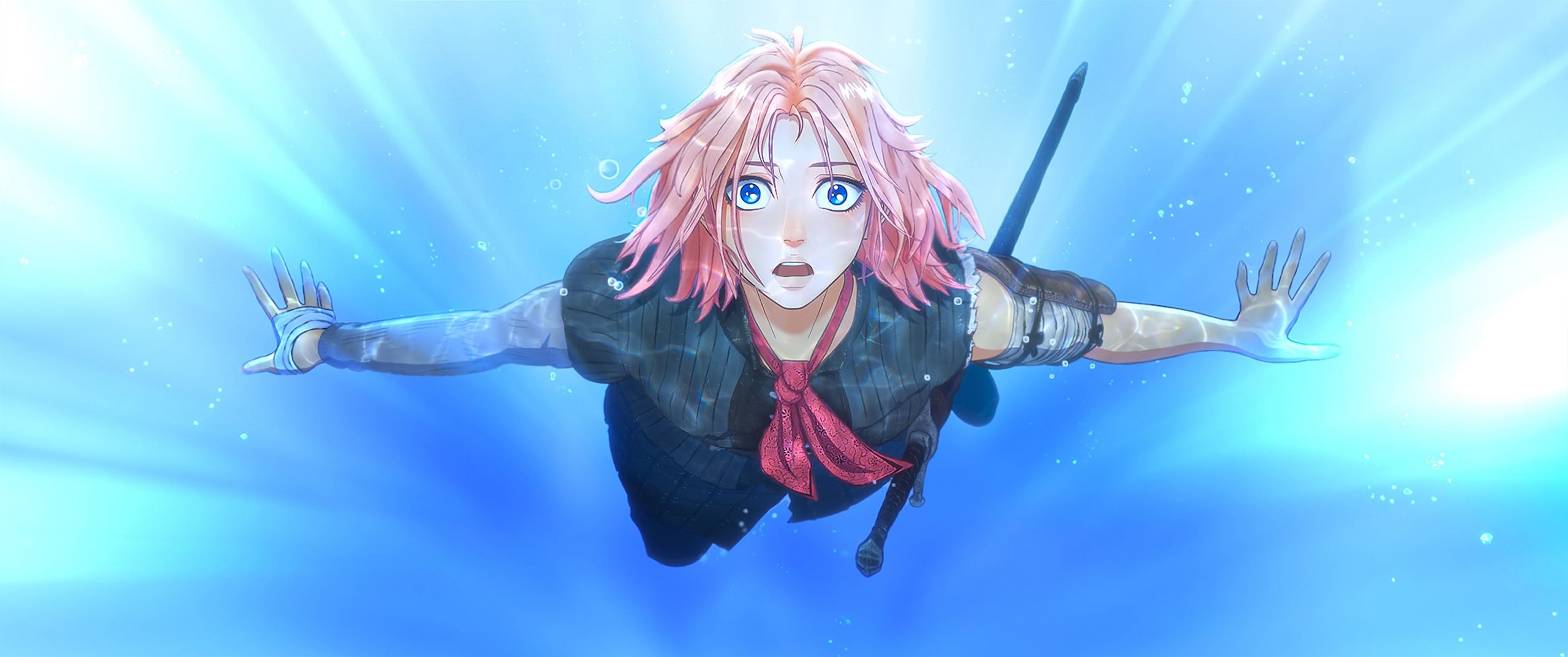

Hosoda is one of the few figures in contemporary anime whose filmography carries genuine thematic consistency. He co-founded Studio Chizu in 2011 and has released every film since Wolf Children through it. With Mirai, he directed the only non-Studio Ghibli anime to receive an Oscar nomination. He was once announced as the director of Howl’s Moving Castle before Hayao Miyazaki took over. Across his work, he has returned repeatedly to young protagonists navigating worlds that ask too much of them, and he has increasingly centered female characters doing exactly that. “I have a daughter,” he says, “and the question of how I depict the world she will live in is always one of the fundamental motivations behind my work.”
Nippon Sangoku Unveils A Gripping Third Trailer Ahead Of Its Global Premiere
Where Scarlet makes its most unexpected move is not in the gender of its protagonist but in what it does with revenge itself. After training with the ferocity of someone with nothing left to lose, Scarlet eventually learns that her father’s dying wish was not retribution but forgiveness. It is a turn that reframes the entire film, and Hosoda is precise about why he made it. “In real life, even if revenge is achieved, what has been lost does not truly return,” he says. “The emptiness that remains afterwards can be even greater.” He is not asking his audience to abandon their anger. He is asking them to consider what it costs to let anger become the whole story. In a cultural moment where cycles of retaliation feel increasingly permanent and political, it is a quieter and more demanding argument than most blockbusters are willing to make. Scarlet is not about a hero who saves the world. It is about a girl who decides her life is worth more than the wound that almost defined it.