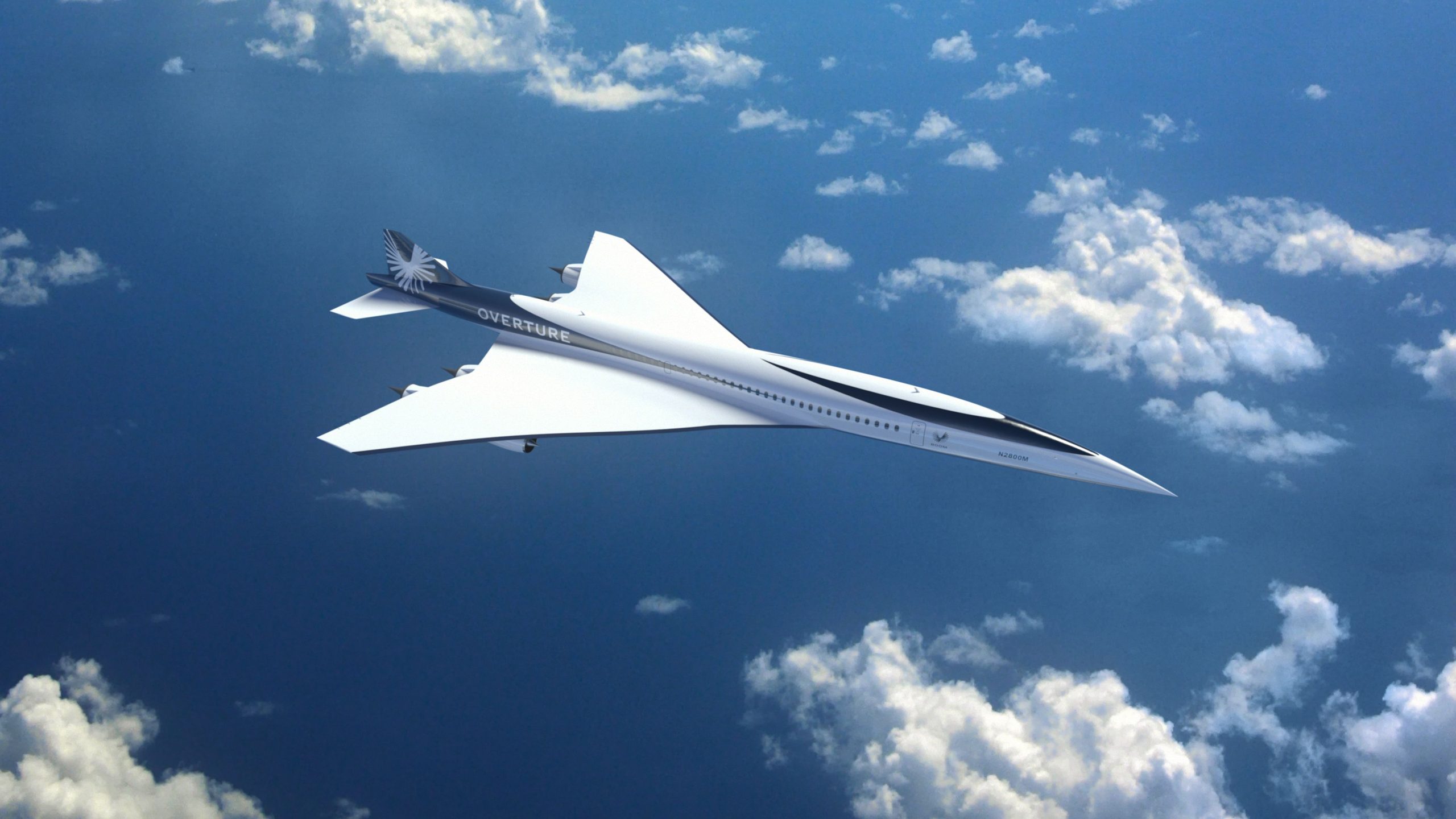

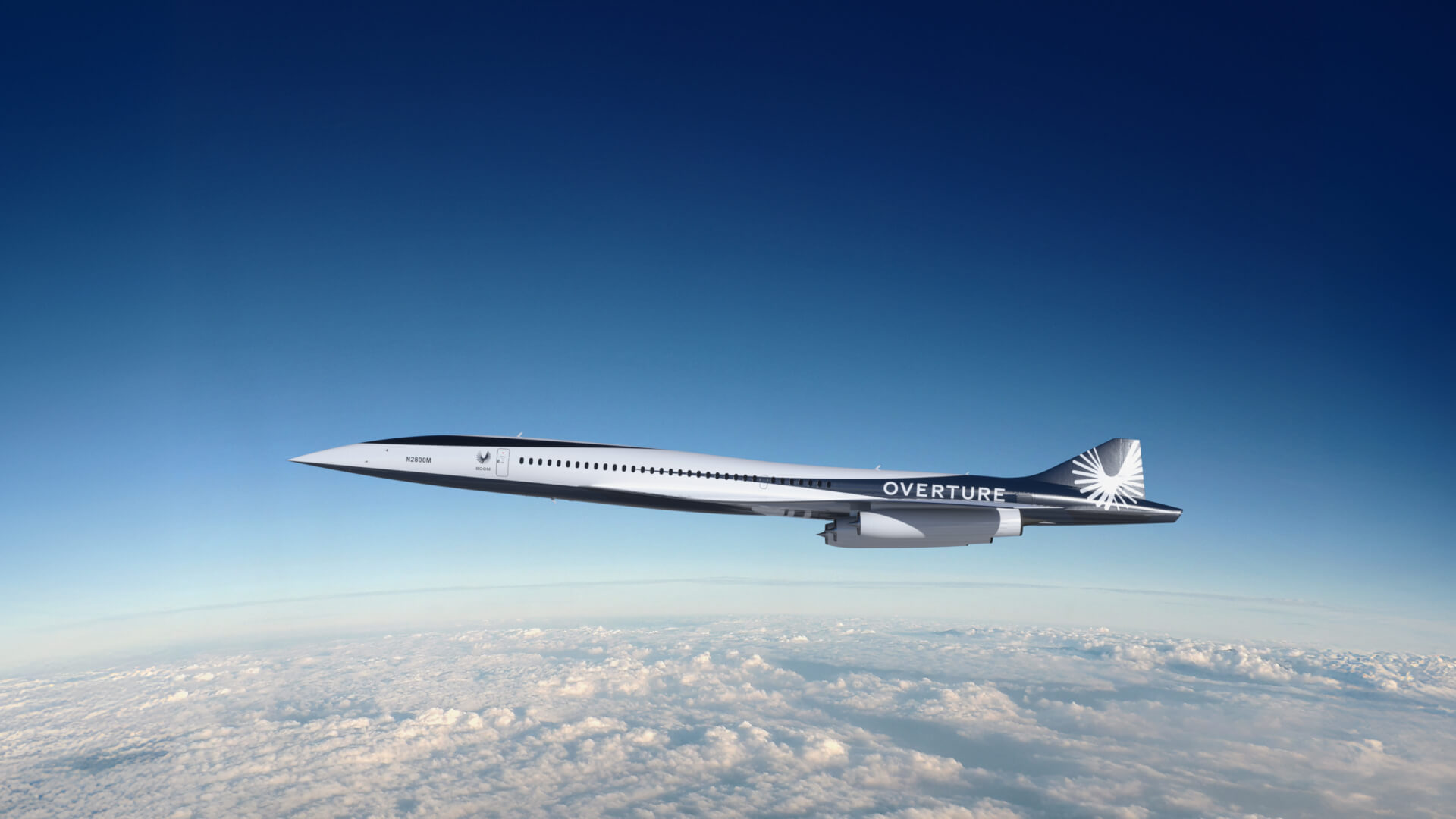
“Our ultimate goal is to bring the benefits of supersonic flight to everyone,” says Blake Scholl, the founder and chief executive of Boom Supersonic. His Denver based company is at the forefront of the modern race to find a successor to the legendary Concorde. The chosen name for this new aircraft is Overture, a plane that Boom says will cut travel times in half and usher in a new era of faster travel. The vision is compelling enough to have attracted 130 orders and options from major carriers like American Airlines, United, and Japan Airlines.
Earlier this year, the company’s supersonic test plane, XB1, became the first independently funded jet to break the sound barrier, a major milestone on the path to realizing their goal. The production plane, Overture, is designed to fly at 60,000 feet, just like Concorde. Its speed of Mach 1.7 is slightly slower than its predecessor but still twice as fast as today’s conventional aircraft. The company claims a London to New York flight will take just three hours and 45 minutes, a time comparable to Concorde’s historic schedule.
Bandit9 Unveils Limited Edition Custom Ducati 821
However, the shadow of Concorde looms large. Had the iconic jet not been retired on commercial grounds, its environmental impact would likely have grounded it by now. A single London to New York trip burned through 100 tons of fuel for about 100 passengers, whereas a modern Boeing 787 carries three times as many people for half the fuel. Boom Supersonic says Overture will run on 100 percent sustainable aviation fuel (SAF), though critics remain skeptical about the scalability and true benefits of this scarce resource.
The other major environmental hurdle is noise. Concorde was famously banned from flying at supersonic speeds over land because of the powerful sonic boom it created. Boom believes it has a solution to this problem, which it calls “Boomless Cruise.”
“By flying at a sufficiently high altitude at an appropriate speed for current atmospheric conditions, Overture’s sonic boom never reaches the ground. When in Boomless Cruise, speeds are 40-50 per cent faster than conventional airliners. This means a flight from New York to Los Angeles can be up to 90 minutes shorter. At top speeds of Mach 1.7, flight times are twice as fast and sonic booms are only created over water.”
Hyundai Unleashes 640 HP IONIQ 6 N Performance EV at Goodwood
With a range of 4,890 miles, Overture opens up the possibility of more than 600 profitable routes worldwide, connecting cities like London to Miami and Los Angeles to Lima. The company also projects that fares will be comparable to subsonic business or first class, a significant departure from Concorde’s premium pricing. This vision has earned the support of key industry veterans, including Captain Mike Bannister, the former chief pilot for Concorde.
“I’ve been waiting over 20 years for an environmentally friendly successor to Concorde and XB-1’s supersonic flight is a major landmark towards my dreams being realised. When I last flew Concorde in 2003 I knew that this day would come.”
Despite this optimism, some senior figures in aviation believe the world has fundamentally changed. They argue that the primary market for supersonic travel, high stakes business meetings, has been largely replaced by technology. Jonathan Hinkles, a senior aviation executive, shared his doubts.

“Today we’ve got Zoom, we’ve got Teams. A lot of business meetings that were the bedrock of why people flew on Concorde don’t actually require people to fly anymore. The market that supported Concorde through its life has moved on fundamentally. I just can’t see that there’s an economic case for a successor.”
Lyn Hughes, the founding editor of Wanderlust magazine, agrees that traveler priorities have shifted away from pure speed. “I think the public are less concerned now with the speed of the flights than they are with other factors: safety, convenience, reliability, value for money and comfort. The real revolution now would be a better experience at the airport pre and post the flight, and a comfortable experience on it – and, of course, for a more sustainable, carbon-free flight.”
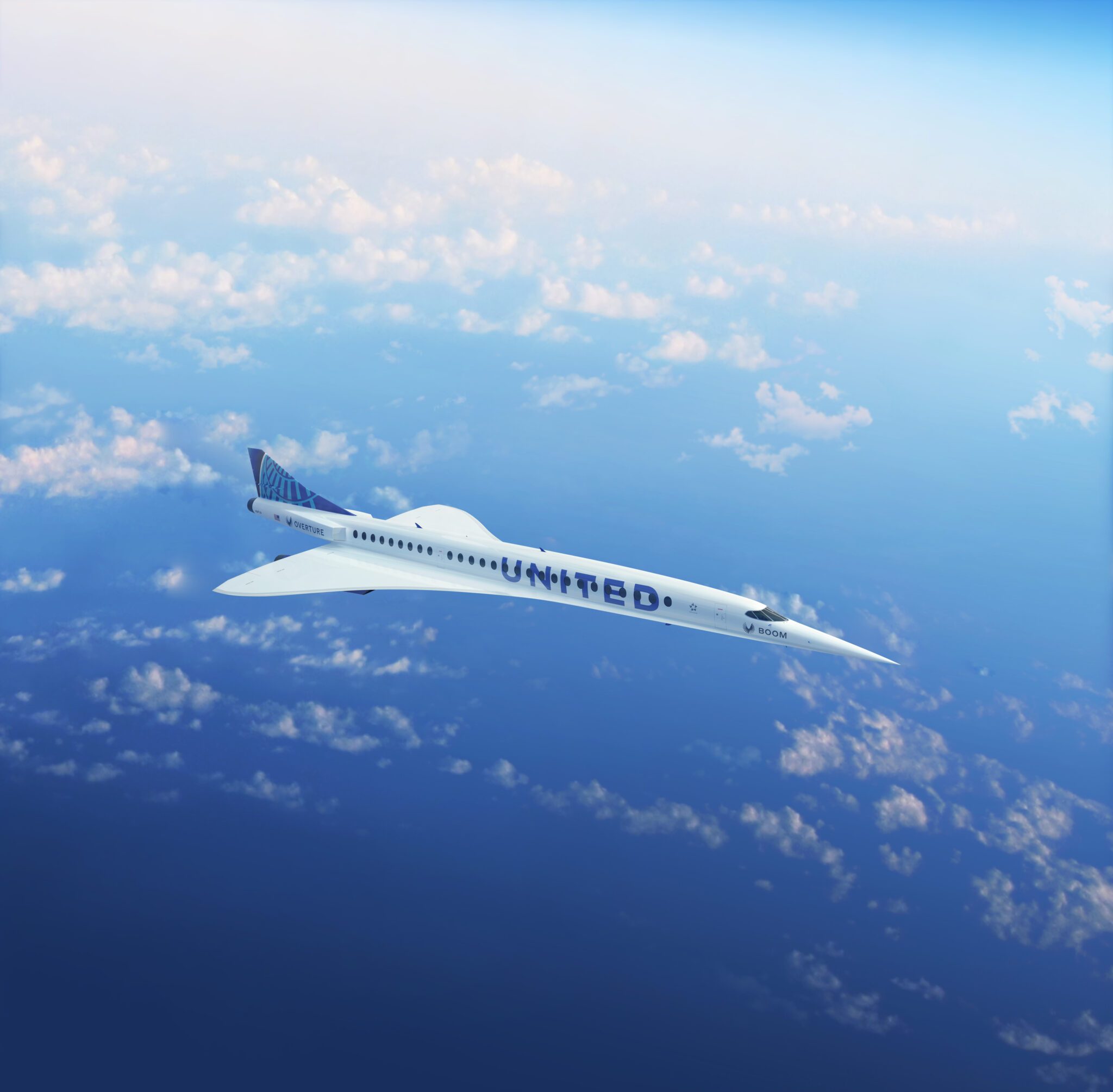
Still, Boom’s founder Blake Scholl remains convinced that speed will ultimately win. “We believe in a world where more people can go to more places more often,” he says. “Sustainable supersonic travel unlocks new possibilities for business relationships, prospects for vacation and opportunities for human connection.” The race is on to see if his vision for a faster future can take flight in a world that may have learned to slow down.